
I Owe You Something.
An inside look at the creative career book shaped by its audience


Six months ago, I started an experiment: What if I used a design process to write a career book? Through the process of iterating, testing, and refining, I hoped to make something genuinely useful to readers like you.
If you’re receiving this post by email, you’ve been part of that process. (If not, you still have time to join.) There have been over 100 responses to surveys, feedback forms, and A/B tests. With your help, I’ve sharpened the focus of my book.
You’ve been very generous with your time and now, I owe you an update.
In this note, I’ll explain how your feedback shaped the structure and content of this book. We’ll dive into chapters, sidebars, and interviews.
Right now, I’m calling it Career by Design. Back in January 2025, I conducted a survey and that title won by a 42% margin. Readers, who primarily work in creative fields like design and illustration, liked the clarity and double meaning of the title. Design a Job That Doesn’t Suck trailed behind at 28%, with some readers appreciating the title’s sense of humor. Design Your Finish Line came in third, but readers were confused it might be a retirement guide. (It’s important to note that most of these readers range from entry- to mid-level experience.)
That sparked an idea for the structure.
The Chapters
While Design Your Finish Line wasn’t the right title, the idea of retirement sparked the following chapter structure, which roughly follows a career path:
1. Design Your Starting Line
2. Design Your Business
3. Design Your Edge
4. Design Your Network
5. Design Your Confidence
6. Design Your Story
7. Design Your Pivot
8. Design Your Finish Line
But that chapter structure didn’t emerge just from an unused title.
In another survey, I tested three structures. Among 35 participants, the favorite was a practical structure, focused on career-related topics such as finding your first job, achieving financial stability, networking, and pivoting. The least-favorite was a structure that traced decades of your life. Readers said: “Creative career paths aren’t linear.” (That stuck with me…in a good way.)
Many were curious about a design-related structure, but only if it enhanced their understanding of the topics. (Message received: don’t let cleverness get in the way of usefulness.)
The Content
During the winter and spring of 2025, we sharpened the content. We broke into smaller focus groups. I conducted A/B tests of different formats and approaches to the text. In some versions, readers felt like the career advice was too prescriptive, in others, I wrote overly long case studies.
Many readers wanted more of my personal story and insights.
This idea of a non-linear career path kept poking at me. How could I offer career advice when everyone’s creative interests are so different? (For example: I know a creative director who now runs a lemonade stand.) We’re not a bunch of Patagonia-vested finance bros chasing the same finish line. We all have different goals, different measures of success.
So, I thought back to my first book, Creative Endurance. It was built around rules. Creatively, I never want to do the same thing twice. What if this next book were built around questions?
That sparked an idea for the format.
Following the chronology of my not-so-linear career, each chapter opens with a personal story—which isn’t always tied a success. That sets the stage for a big, propulsive question like “What happens when your career begins off track?” or “Is it possible to train your confidence?” From there, I wrestle with the question through the case studies, ultimately arriving at my conclusion, which invites you, the reader, to come up with your own.
This amounted to 20,000 words. Two weeks ago, I delivered it to my editor, Sean Evans. (His book, How to Survive Against the Odds, just came out a few months ago. It’s based on the podcast, Against the Odds.)
Finishing that draft gave me room to think about the sidebars—that essential part of the book that drives ideas into action. We’ll get to those in a minute. But first…
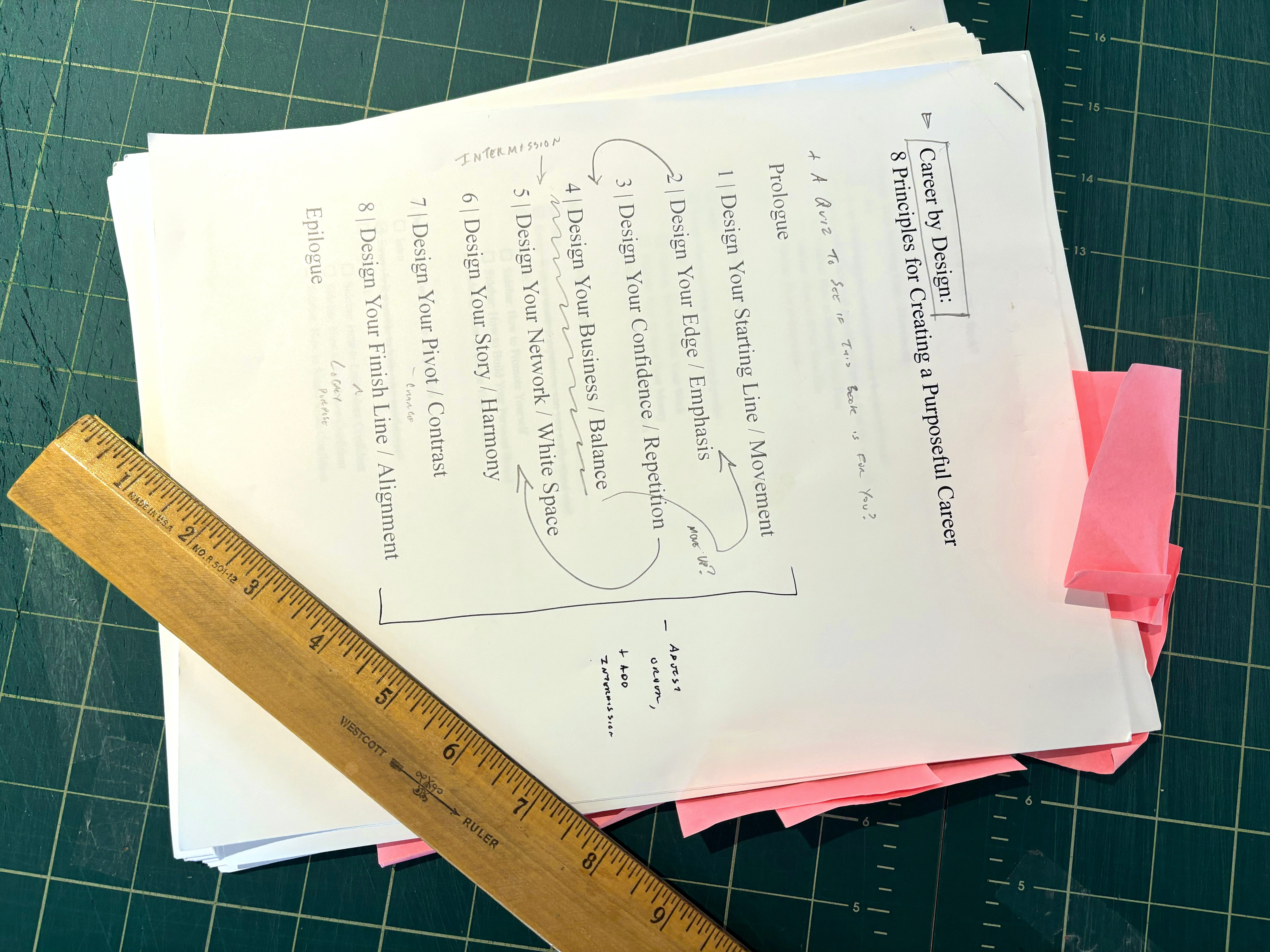
A pic of the manuscript so far. Ruler added for good measure. 🥁 Ba-dum-bum. 🥁
The Interviews
I’ve spoken to 30 people so far. They include:
• Steven Smith, the godfather of dad shoes.
• Gillian Flynn, the author of Gone Girl.
• Mark Rober, a YouTuber.
• Maggie Gray, a sports radio host.
• Lonnie Johnson, the inventor of the Super Soaker.
• Brian Collins, a graphic designer.
• Mastodon, my favorite heavy metal band.
I also interviewed a body language expert, a helicopter pilot, a fashion director, a financial advisor, a therapist, a synthetic biologist-turned-creative director, a medical doctor-turned-illustrator, freelance photographers, all kinds of designers, and a guy who sold his home and quit his job to travel the world for five years.
These interviews turned into those case studies and the following sidebars—some informative, some surprising.
🤔 Who else would you like me to interview?
The Sidebars
This book will have over 20 sidebars, each in a how-to format. Why? Because in a sidebar survey earlier this year, 79% of you asked for actionable steps and everyday habits. 55% of you want challenges reframed as opportunities. Only 18% were looking for science-backed proof.
I asked about topics you’re interested in, and your responses helped shape my list. Here’s what I have in the works:
How to:
• Write your bio
• Interview
• Manage your time
• Save your money
• Differentiate your business
• Price your work
• Promote yourself
• Find an agent
• Build your portfolio
• Write shorter, stronger messages
• Connect with others
• Be a mentor
• Feel more confident
• Look more confident
• Sound more confident
• Tell your story at a conference
• Tell a story about a success
• Tell a story about a failure
• Launch a pivot
• Finance a pivot
• End a pivot
• Quit your job and travel the world
• Find an important cause
• Build a life outside of work
🤔 What else would you like to read about?
I can’t wait to share prototypes of these sidebars. I also plan to write explainers on pressing, somewhat vague topics: imposter syndrome, personal branding, and burnout.
So far, this experiment has worked better than imagined. I’ve learned how to read the data, but also trust my creative intuition. With your help, I’ve shaped the structure and format, making this a more useful book. And I’m sure it’ll keep evolving through the design process.
Well, that’s enough for now.
I’ll share another update when the content’s sharper. After that, we’ll talk design. Oh—and eventually, I’ll tell you a story about why I decided to write a second book.
I have to say: a long-term project like this is a total bear. Between ideation, interviews, and a few false starts, I’ve been working on this thing for two years now. But it’s also a lot of fun, because it’s given me a chance to connect with old friends and make some new ones.
Whether you’re an old friend, a new one, or somewhere in between, you’re a part of this. And if you know someone who might enjoy the process, invite them to join along.
Until next time,
Mike